“Seek First the Kingdom”
Notes
Transcript
Most of us don’t wake up anxious. We wake up needed.
Before our feet hit the floor, the list is already running: who needs to be where, what has to be paid, what decision can’t wait, what conversation we’ve been avoiding, what might go wrong if we don’t stay on top of it.
For a lot of us, anxiety doesn’t feel like panic. It feels like responsibility. It’s not shaking hands. It’s a tight chest. A busy mind.
Parenting pressure.
Financial obligation.
Career expectations.
The quiet weight of making sure everything—and everyone—keeps moving forward.
And in a place like Midland, that pressure runs especially deep. We’re planners. Providers. Problem-solvers. We’ve learned to read cycles, anticipate downturns, and stay a step ahead. We don’t just react—we prepare. Because many of us have watched how quickly a ‘normal season’ can change.
So our minds stay crowded and our hearts rarely get quiet. Morning routines are efficient but heavy. Family schedules overlap and compete. The mental checklist starts before coffee and doesn’t really shut off at night.
And none of this feels irresponsible. In fact, it feels like maturity.
We don’t say, “I’m anxious.” We say, “I’ve got a lot on my plate.”
We don’t say, “I’m afraid.” We say, “People are counting on me.”
We don’t say, “I’m overwhelmed.” We say, “This is just the season I’m in.”
But over time, something happens. That constant sense of responsibility starts to feel like the measure of our lives. Like if we don’t keep everything together, everything might come apart. And if we’re honest, it can start to feel like, “If I don’t hold it all together, nobody will.”
And into that pressure—Jesus speaks words that sound gentle, but cut straight to the center. And if you’re new to church or new to Christianity, Jesus isn’t about to shame you for being stressed—he’s going to show you where real peace comes from. Up to this point in our series, we’ve been exposing false centers. Today, Jesus begins to give us the true one.
“Therefore I tell you,” Jesus says,
Don’t worry about your life…
Those words can sound jarring—almost dismissive—if we hear them the wrong way. Because Jesus is not minimizing real needs. He’s not denying financial realities, family responsibilities, or the weight of tomorrow.
Jesus isn’t scolding anxious people. He’s diagnosing something deeper.
Because anxiety, as Jesus speaks about it here, isn’t just fear of the future. It’s what happens when “I” quietly becomes the center—when I start living like everything depends on me—when the responsibility for holding life together shifts, almost imperceptibly, onto our shoulders.
Jesus doesn’t say, “You shouldn’t care.” He says, “Look at what you’re carrying.”
He doesn’t argue with anxiety. He exposes its source.
And that creates the tension we have to sit with before we go any further:
What if anxiety isn’t just about what might happen—but about who we believe is responsible for making sure it doesn’t?
That question changes the conversation. Because this isn’t a call to “just stop worrying.” It’s not prosperity logic. It’s not denial of hardship.
It’s an invitation to see that anxiety often grows where our trust gets misplaced—where responsibility has quietly turned into control, and care has turned into burden-bearing we were never meant to shoulder alone.
Jesus is about to re-center everything—not by telling us to care less, but by calling us to seek first something greater.
And if he’s right—if peace really does follow when God comes first—then anxiety may not be a personal failure…
It may be a sign that something in our lives is out of order.
And that’s where Jesus takes us next.
Anxiety Grows When the Self Is the Center
Anxiety Grows When the Self Is the Center
When Jesus begins to address anxiety in Matthew 6, he doesn’t start by telling people what to stop feeling. He starts by showing them what they’ve been centering their lives on.
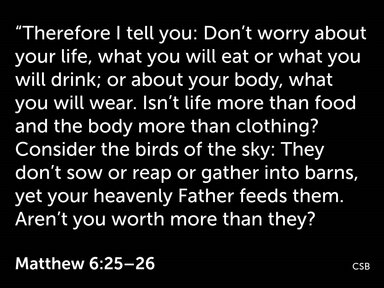
Matthew 6:25 “Therefore I tell you: Don’t worry about your life…what you will eat…what you will drink…what you will wear.”
Jesus names the most basic human concerns. Not luxury. Not excess. Not indulgence. Food. Drink. Clothing.
In other words, Jesus assumes real need. He’s not speaking to carefree people with nothing at stake. He’s speaking to people who wake up every day knowing that provision matters, that responsibility is real, and that tomorrow doesn’t take care of itself.
And yet, as Jesus speaks, there’s a subtle emphasis we might miss if we’re not paying attention. Jesus keeps saying ‘you’ and ‘your life’ because he’s showing us where anxiety lives: when life is centered on me.
When anxiety takes hold, everything starts circling around me.
Will I have enough?
Will I be okay?
Will I hold this together?
Will my efforts be enough?
Anxiety flourishes when meaning, provision, and outcome all rest on one small point: me.
That’s why Jesus doesn’t shame anxious people—he reorients them.
He points to birds in the air. They eat. He points to lilies in the field. They’re clothed.
And Jesus is careful here. Birds aren’t lazy. Lilies aren’t careless. They still live inside God’s world—and they’re cared for inside it. They exist within the order God has given them. They receive what they cannot produce.
Jesus isn’t saying, “Stop working.” He’s saying, “Notice who sustains.”
The birds don’t wake up believing the universe depends on them. The lilies don’t carry the pressure of proving their worth.
They receive life as gift, not as performance.
And then Jesus asks the question that quietly exposes the heart of anxiety: Matthew 6:26 “Are you not of more value than they?”
This is not a guilt-inducing question. It’s a re-centering one. Because anxiety is not weakness—it’s misplaced trust.
It’s what happens when the self is asked to carry weight it was never designed to bear. When the burden of provision, meaning, and outcome collapses inward.
And this is where the series comes sharply into focus.
Think about the series so far: work can’t give meaning, achievement can’t give identity, possessions can’t guarantee life, and control can’t secure tomorrow. And now Jesus names what sits underneath all of it—living like everything depends on us.
Different expressions. Same center.
And that’s why anxiety feels so heavy. Because the self was never meant to be the center of the universe. It was never meant to be the source of meaning, provision, and control.
Many of us live with the quiet fear: If I don’t stay on top of this, it all falls apart. If I let go. If I slow down. If I trust too much.
But Jesus is gently revealing the truth we rarely name: the weight we’re carrying was never ours to begin with.
Anxiety grows where the self sits at the center of the universe.
And Jesus doesn’t expose that to condemn us. He exposes it so he can invite us into something lighter, freer, and truer.
Because if the self is not the center—then something, or Someone else must be.
And that’s where Jesus takes us next.
Jesus Reorders Our Loves Before He Relieves Our Fears
Jesus Reorders Our Loves Before He Relieves Our Fears
After Jesus names anxiety and exposes its center, he does something important—he doesn’t immediately try to calm us down. He doesn’t offer techniques or reassurance first. He reorders what we love.
Matthew 6:31-32a “So don’t worry, saying, ‘What will we eat?’ or ‘What will we drink?’ or ‘What will we wear?’ For the Gentiles eagerly seek all these things…”
“Gentiles” is Jesus’ shorthand for people who live without reference to God—people who feel like they have to secure everything on their own. Jesus says ‘seek’—meaning what you chase, what you build your life around.
Jesus isn’t criticizing the existence of needs. He’s naming what people organize their lives around. What they chase. What they prioritize. What quietly defines what matters most.
And Jesus is very clear: he is not shaming need. Food, drink, and clothing are not sinful desires. They are human ones. The problem is not caring about these things—it’s seeking them as if they were ultimate.
Jesus contrasts two ways of living.
On the one hand: a life oriented around securing enough. On the other: a life anchored in trusting Someone.
Matthew 6:32a “The Gentiles seek after these things,” Jesus says—not to insult, but to describe a way of living without reference to God. A life where meaning and security must be managed, produced, and protected by the self.
And then Jesus says something that should land like relief: Matthew 6:32b “Your heavenly Father knows that you need them all.”
Notice the shift. From what you seek to who knows.
Jesus doesn’t argue that needs are imaginary. He argues that they are already known. Already seen. Already accounted for by a Father who is not distant or indifferent.
Which means anxiety isn’t just about fear—it’s about love.
What do we love most?
What do we trust to define what’s enough?
What do we believe will keep us safe?
That’s why Jesus doesn’t offer anxiety management—he offers love reordering.
Matthew 6:33 “But seek first the kingdom of God and his righteousness, and all these things will be added to you.”
By ‘kingdom,’ Jesus means God’s rule—God being in charge. And ‘righteousness’ means living God’s way, not just my way.
To seek first the kingdom is not to become less human. It’s to become rightly ordered.
The kingdom of God means:
Jesus’ reign defines what matters.
Jesus’ care defines what’s enough.
Jesus’ presence defines what’s safe.
And this is where we have to be very clear—because “the kingdom” is not an abstract idea.
The kingdom of God is embodied in Jesus himself. To seek the kingdom is to entrust your life to the King. To place your future, your family, your needs, and your fears into the hands of Christ.
Jesus is not saying, “Stop caring about outcomes.” He’s saying, “Stop making outcomes your god.”
This is where anxiety often lives in ordinary, faithful homes.
We want our kids to turn out okay. We want our marriages to hold. We want our work to matter. We want our efforts to be enough.
And that desire isn’t wrong—but it becomes heavy when we believe it all depends on us.
At some point, every parent realizes this truth: you cannot guarantee outcomes. You can guide, love, pray, and show up—but you cannot control the future.
And Jesus meets us right there.
He doesn’t ask us to stop caring. He invites us to stop carrying what only God can hold.
Seeking first the kingdom is not withdrawing from responsibility—it’s relocating trust—from the self to the reigning Christ.
It’s saying:
My life does not rest on my ability to manage everything.
My security does not come from my vigilance.
My worth does not depend on how well I hold this together.
Jesus is not minimizing your fears—he’s giving them a new place to rest. Because when our loves are reordered, fear begins to lose its grip.
Not because life becomes predictable—but because it becomes entrusted. And that’s why Jesus can move us, gently but firmly, toward the assurance that comes next.
The Kingdom Frees Us From the Tyranny of Tomorrow
The Kingdom Frees Us From the Tyranny of Tomorrow
After Jesus names anxiety, exposes its center, and reorders our loves, he brings everything to a surprisingly simple conclusion:
Matthew 6:34 “Therefore don’t worry about tomorrow, because tomorrow will worry about itself. Each day has enough trouble of its own.”
At first glance, that can sound dismissive—almost like Jesus is brushing off real concerns. But he’s not minimizing difficulty. In fact, he acknowledges it plainly.
Matthew 6:34b “Each day has enough trouble of its own.”
Jesus does not deny that today is hard. He does not promise that tomorrow will be easier. He does not pretend that worry is irrational or unnecessary.
What he does is dignify today.
Jesus draws a boundary—not around responsibility, but around time. He refuses to let tomorrow dominate today. He will not allow imagined futures to rob us of present faithfulness.
And that matters, because anxiety almost always lives one day ahead.
Anxiety borrows trouble from tomorrow and demands that we carry it now. It insists that we anticipate every outcome, prevent every loss, and manage every risk before it arrives.
Jesus names that impulse for what it is: tyranny.
Tomorrow becomes a cruel master when we try to live there before God sends us there.
And notice—Jesus doesn’t say tomorrow won’t have trouble. He says it will. But it will have its own grace, its own provision, its own sustaining mercy when it arrives. Meaning: God will give tomorrow’s help…tomorrow.
The problem is not uncertainty. The problem is relocation—trying to live in a day God has not yet given.
This is not fatalism. This is not passivity. This is not “whatever happens, happens.”
This is active trust in a reigning King.
Jesus is not telling us to stop planning. He’s telling us to stop letting the future rule us. He’s calling us to live where grace actually operates—today.
And here’s the heart of Christianity.
The Father who clothes the lilies clothed his Son in flesh. The Father who feeds the birds fed the world through the cross. In other words: Jesus does not point us to a kingdom he hopes might come. He points us to a kingdom he secures.
The kingdom he tells us to seek is the kingdom he inaugurates, embodies, and guarantees. A kingdom where God’s reign is not theoretical, but personal. A kingdom where care is not abstract, but costly.
When Jesus says, “Do not be anxious about tomorrow,” he says it as the One who will carry tomorrow on his own shoulders. The One who will enter suffering, absorb sin, and defeat death so that our future is not fragile, even when our circumstances are.
Which means peace does not come from controlling tomorrow.
Peace comes from belonging to a King today.
Belonging reorients time.
Today becomes the place of obedience. Today becomes the place of trust. Today becomes the place where God meets us—not with certainty, but with presence.
And that is freedom.
Not freedom from trouble—but freedom from having to outrun it. Not freedom from responsibility—but freedom from pretending we are ultimate. Not freedom from planning—but freedom from presumption.
When the kingdom comes first, tomorrow loses its grip.
Because the future is no longer something we have to secure—it is something we receive.
And that is where Jesus wants us to live.
Not anxious about tomorrow. Not crushed by what might be. But faithful, attentive, and trusting—today.
Because the kingdom of God is not waiting for us in the future.
It is already among us in Christ.
And that is why anxiety does not get the final word.
The King does.
Now, before we rush to do anything, I want us to slow down long enough to notice what Jesus has already revealed.
Because Jesus doesn’t respond to anxiety with instructions first—he responds with reorientation.
So the application here is not to fix your schedule, revise your budget, or master your emotions. It’s to let anxiety tell you the truth about what you’ve been carrying.
Worry can be a warning light—not because it’s good, but because it tells the truth about what we’re trying to carry. It reveals where trust has quietly shifted.
So let me ask these questions slowly—not for quick answers, but for honest attention:
Where has anxiety or worry revealed misplaced trust in your life? Not where you feel nervous—but where you feel responsible for outcomes you cannot guarantee.
Where have you been asking yourself to play God? To hold it together. To get it right. To make sure everything turns out okay.
What would it look like—not tomorrow, not eventually—but today, to seek Christ before solutions?
Because anxiety and worry often shows up when “I”, the self, becomes central—when meaning, provision, and outcome quietly orbit around us. And Jesus, without shaming us, invites us to shift the center of gravity back where it belongs.
Let me say the bottom line gently here, because this frames the work the Spirit is doing right now:
Peace comes from seeking God’s kingdom.
Peace comes from seeking God’s kingdom.
Not because the kingdom removes all uncertainty—but because it relocates trust.
This is not about caring less. It’s about carrying less. It’s about letting Christ be who he already is—King—rather than asking yourself to be.
So don’t rush past the questions. Don’t judge the answers. Just let the Spirit re-center you where peace actually grows.
If the application slows us down, the gospel now lifts our eyes.
Jesus grounds everything he says about anxiety in assurance: Your Father knows what you need. Your Father sees what concerns you. Your Father is already at work before you ask.
You are not unseen. You are not forgotten. You are not carrying this alone—even when it feels like you are.
And the kingdom you’re invited to seek is not fragile. It is not hypothetical. It is not hanging by a thread.
It has already been secured.
The kingdom Jesus calls us into is the kingdom he embodies. The reign of God that feeds birds and clothes lilies is the same reign that sent the Son, bore the cross, and conquered the grave.
Which means your peace does not rest on your ability to manage life well. It rests on Christ’s finished work.
Jesus does not say, “Seek the kingdom so God will start caring.” He says, “Seek the kingdom because God already cares.”
That’s the relief. That’s the reorientation. That’s the hope.
You are not invited into striving—but into trust. Not into vigilance—but into belonging.
And when you belong to a King like this, anxiety no longer gets the final word.
Grace does.
So how do we respond?
Not by trying harder. Not by promising to worry less. Not by putting pressure on ourselves to feel different.
We respond by coming under the reign of Christ. And if you’re not sure what you believe yet, that can start with a simple prayer: ‘Jesus, I need your help—teach me to trust you.’
If you’re tired of carrying what you were never meant to hold—come to the King who already carries you.
If you’re exhausted from feeling like everything depends on you—come to the One on whom everything already depends.
If anxiety has revealed how heavy life has become—let that weight lead you to rest, not resolve.
Let me say the bottom line one more time, clearly and confidently, because this is what we rehearse together as the people of God:
Peace comes from seeking God’s kingdom.
And seeking the kingdom does not mean escaping your life—it means entrusting it to Christ.
So as we respond in song, let this be a moment of assurance and reorientation.
Not loud. Not rushed. Not pressured.
Just a quiet, confident return to the truth:
“I don’t have to be at the center.”
“I don’t have to hold everything together.”
And for the person who has trusted in Jesus Christ exclusively, “I belong to a King who already reigns.”
And as you rest there, trust this: The One who calls you out of anxiety is the same One who promises to care for you. The King who reigns today will still be faithful tomorrow.
